LiDIA: single droplets on demand, in free space
Ejects one sub-nanolitre droplet per trigger, with microsecond timing, so a reaction can be started exactly where and when it is measured.
The problem
Time-resolved experiments at X-ray free-electron lasers and synchrotrons are often limited by how the sample reaches the beam. Continuous liquid jets consume most of the sample between X-ray pulses and cannot be locked to individual pulses. Droplets carried in oil, or held in channels, add material to the beam path that absorbs or scatters X-rays. What is needed is a single, clean droplet, delivered on command to a fixed point in space.
How it works
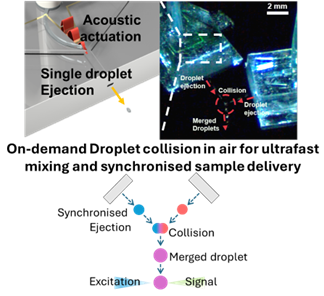
LiDIA (Liquid Droplet-in-Air) forms droplets inside a gas-filled microchannel using a pulsed surface acoustic wave: each electrical trigger produces one droplet. A co-flowing air stream then carries the droplet out of the chip and into free space along a stable trajectory. Two synchronised units can be aimed at the same point so that their droplets collide in mid-air, mixing two reactants at the probe itself.
Measured performance
One droplet per trigger, from single events up to 100 Hz
Droplet volume 756 pL, coefficient of variation 4.7%
Timing jitter 77.5 µs
Trajectory deviation below 5 µm over 2 mm of flight
Mid-air collision of droplets from two synchronised units to start a reaction at the probe
Applications
Time-resolved X-ray and optical spectroscopy; serial crystallography; sample preparation for time-resolved cryo-electron microscopy; interfaces to mass spectrometry; sub-nanolitre dispensing and micro-printing.
Status
LiDIA is available for testing in partners' experiments, including at synchrotron and X-ray free-electron laser beamlines. We welcome enquiries from beamline scientists, structural biologists and instrument developers. See Work with us or contact tuncay.alan@monash.edu.
Key publications
Deng, H.; Jasieniak, J. J.; Alan, T., Precisely timed on-demand droplet ejection and collision in free space for controlled reaction initiation. Small 2026, 22 (53), e74957.
Brenker, J. C.; Devendran, C.; Neild, A.; Alan, T., On-demand sample injection: combining acoustic actuation with a tear-drop shaped nozzle to generate droplets with precise spatial and temporal control. Lab on a Chip 2020, 20 (2), 253–265.